SIZABLE – Scaled prototype of a floating long-duration energy storage system
Sizable Energy is developing an offshore long-duration energy storage system based on pumped brine, designed to store renewable energy at sea and integrate it with offshore generation and infrastructure. Within the SIZABLE project, NOEL supported the development of the technology through numerical modelling, marine operations and at-sea testing of a scaled prototype of the system in the laboratory’s natural basin. The NOEL site, with its regular small-amplitude wind waves, clear water, limited tidal range and steep seabed reaching significant depths close to the shore, made it possible to reproduce scaled offshore conditions and to carry out an experimental campaign on a large and complex floating structure.
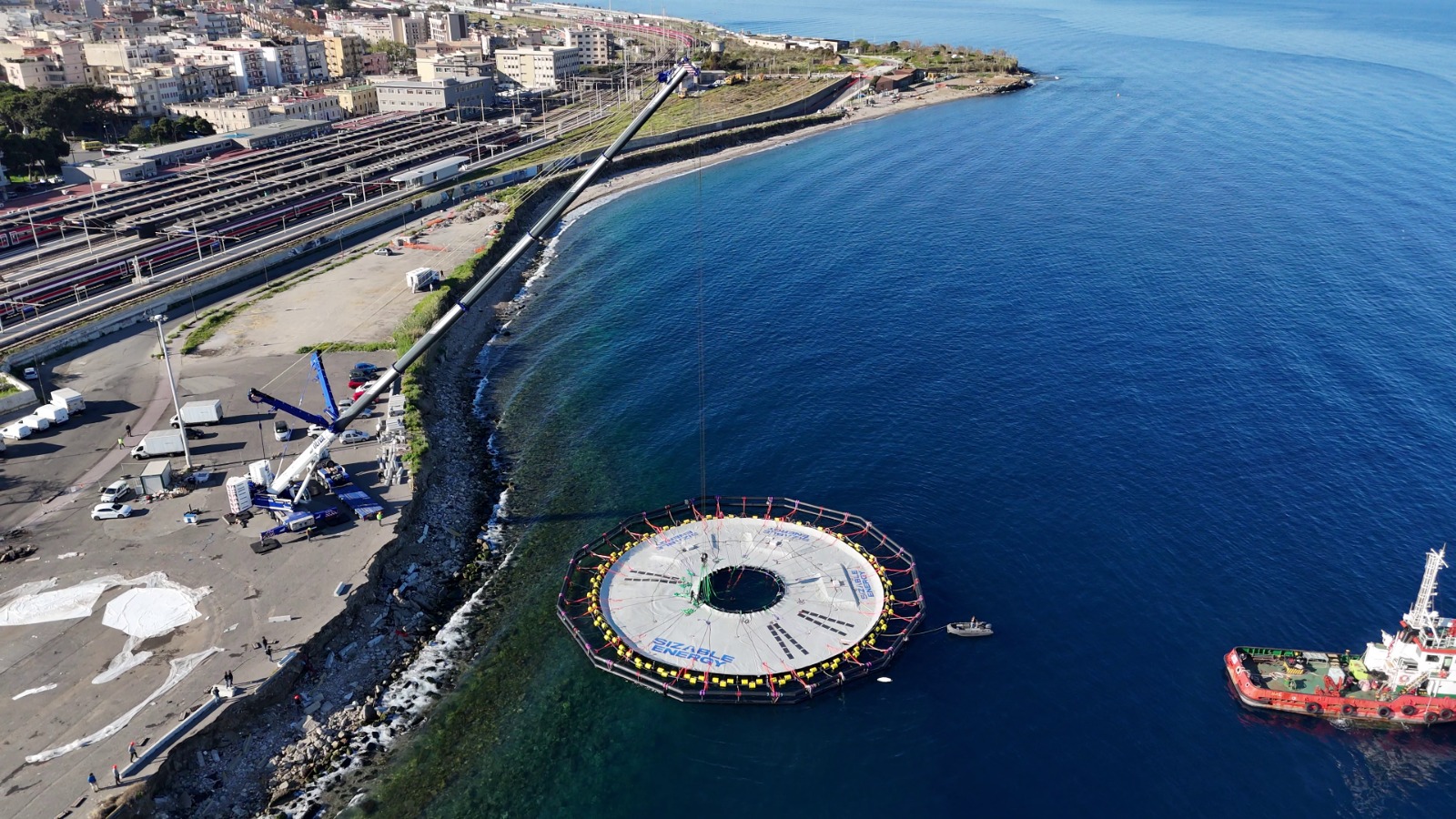
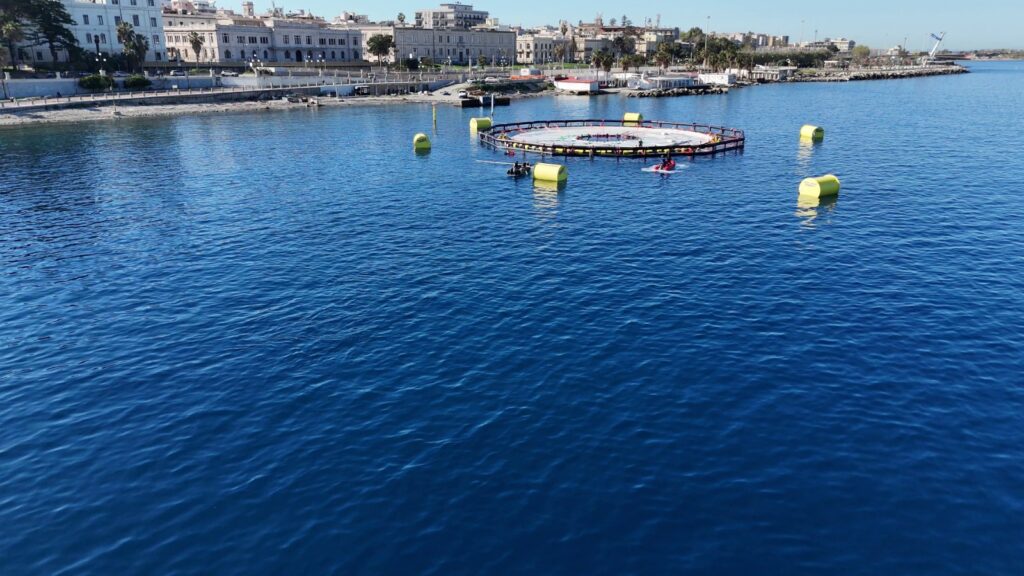
The prototype tested at sea consisted of a modular floating reservoir made of flexible membranes, composed of several segments joined by watertight connections. The reservoir was enclosed by a system of concentric floating barriers made of HDPE pipes, connected to each other by brackets and synthetic ropes, to protect the reservoir and distribute the hydrodynamic forces along the structure. Around the outer barrier, a set of surface decoupling buoys was installed to dynamically decouple the floating structure from the mooring system, reducing load peaks and avoiding local stress concentrations. The buoys were connected to each other in a closed loop and to the outer barrier through radial lines in chain and polyester rope.
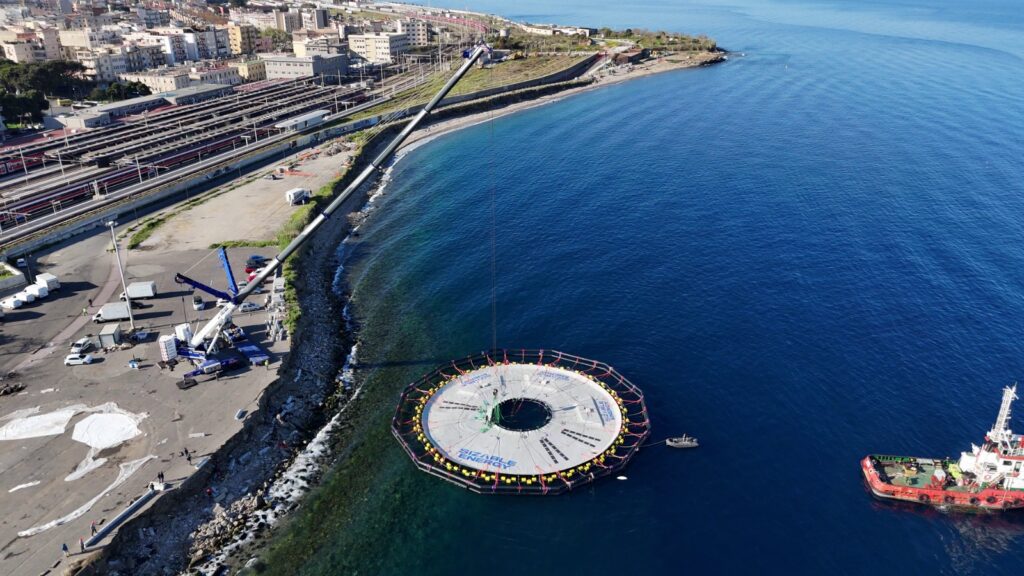
The station-keeping of the system was ensured by a mooring system made of reinforced concrete gravity anchors placed on the seabed at different water depths, each connected to the decoupling buoys through mooring lines in chain and high-performance synthetic rope. The marine operations were carried out in subsequent phases, planned and verified through numerical models: the installation of the gravity anchors and mooring lines, the deployment and temporary positioning of the decoupling buoys, the crane lift and launch of the floating structure, its towing to the test site, and finally the hook-up of all connections and the step-by-step pretensioning of the mooring lines to reach the design geometry.
The experimental campaign made it possible to assess the hydrodynamic behaviour of the floating reservoir and barrier system under real sea conditions, the performance of the decoupling buoy concept and of the mooring configuration, and to validate the installation, towing and mooring procedures. The results support the design and scale-up of the technology toward future full-scale offshore deployments.